
Yesterday (June 3), a plane circled high above Santa Monica carrying three words: “SAY NO TO SUNO.”
Its location in the skies was significant – directly over the UBS AI in Entertainment Summit at the Shutters on the Beach hotel, where Suno CEO Mikey Shulman was among the speakers.
The aerial banner was joined by another flowing behind a second plane, with a missive also aimed at Shulman: “STEALING MUSIC IS BAD KARMA.”
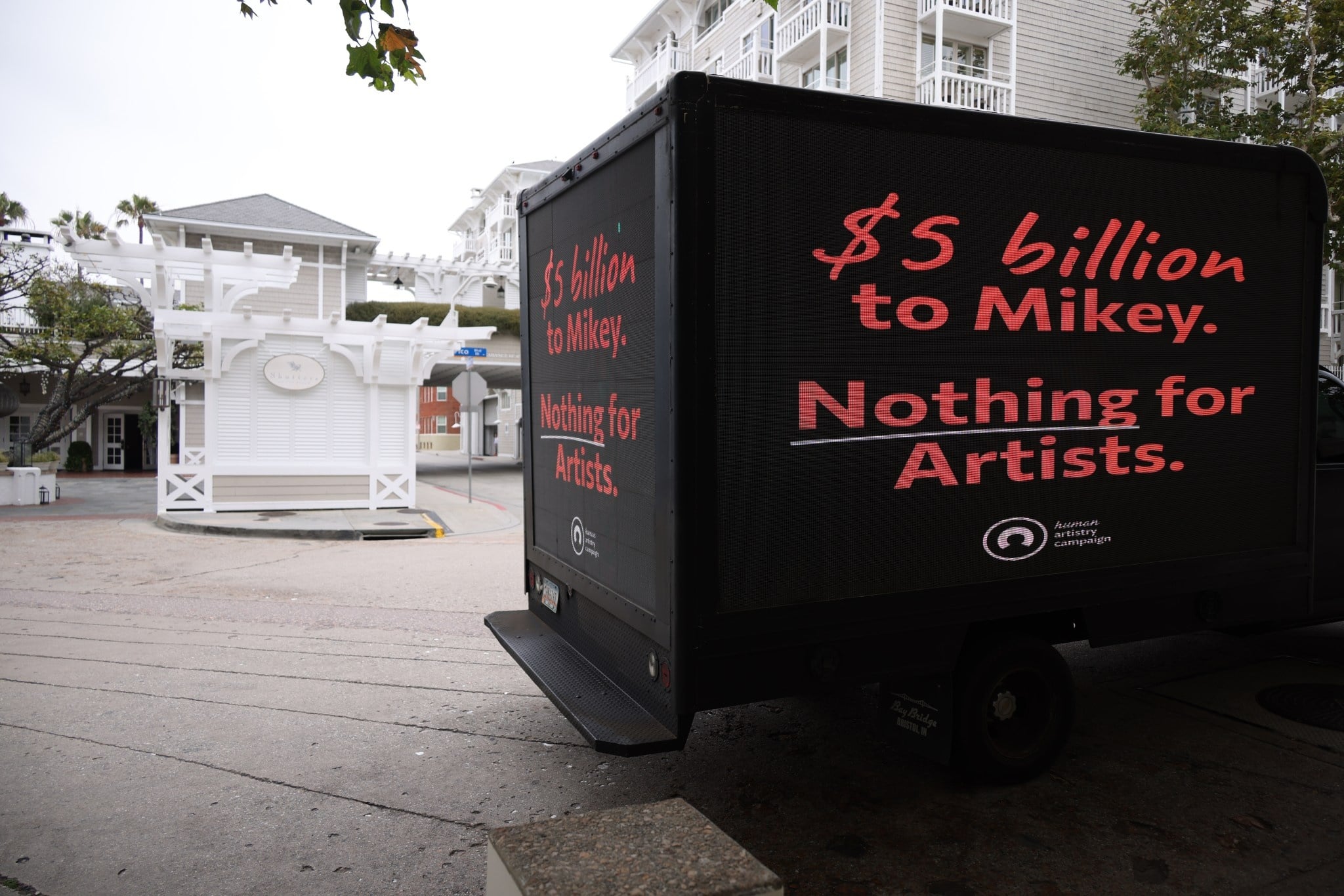
Down below, a truck on the road carried multiple mobile billboards. It too said: “Say NO to Suno!”, as well as “$5 billion for Mikey. Nothing for artists.”
The planes and truck were both sponsored by the Human Artistry Campaign, the artist-rights coalition, according to The Trichordist.
The airborne protest landed on the same day that Suno announced it had raised over $400 million in Series D funding at a $5.4 billion post-money valuation.
The display’s main slogan was not new, of course. “Say No to Suno” first appeared in February, as the title of an open letter online.
Signed by a coalition of artist representatives – including songwriter rep Helienne Lindvall and artist rights advocate David Lowery – the letter described Suno as a “brazen smash and grab” platform built on “unauthorized AI platform machinery trained on human artists’ work”.
This “hijacking of the world’s entire treasure-trove of music floods platforms with AI slop and dilutes the royalty pools of legitimate artists from whose music this slop is derived”, the letter argued.
The Human Artistry Campaign (THAC) has now, quite literally, taken that campaign up a notch.
THAC launched at SXSW in 2023 and now counts more than 70 members.
Among its founding members is the RIAA, which represents over 1,600 recorded music companies – including the three majors, Universal Music Group, Sony Music Entertainment, and Warner Music Group.
It was the RIAA that sued Suno on behalf of the three majors in mid-2024, alleging “mass infringement” of copyright.
One of those majors has notably since struck a deal with the AI company.
Warner Music Group settled its copyright lawsuit against Suno in November, announcing what the two called a “first-of-its-kind partnership”.
“This landmark pact with Suno is a victory for the creative community that benefits everyone,” Warner CEO Robert Kyncl said at the time.
At the UBS summit yesterday, Shulman shared the stage with Kyncl.
Suno‘s new $400 million-plus round was led by Bond Capital and more than doubled the $2.45 billion valuation the company reached seven months ago.
In its funding announcement yesterday, Suno’s Shulman said his company would “in the coming months” begin rolling out “our first music model developed in partnership with the music industry”.
Warner Music Group remains Suno‘s only known music biz rights licensing partner to date.
“In the coming months, we’ll begin rolling out our first music model developed in partnership with the music industry.”
Mikey Shulman, Suno (which is currently being sued for copyright infringement by Universal Music Group, Sony Music Entertainment, and more)
Suno continues to be sued by various parties in the music biz, including Universal Music Group, Sony Music Entertainment, independent artists, and performing rights organizations including Denmark‘s Koda and Germany‘s GEMA.
The Human Artistry Campaign framed its flyover as part of a wider backlash against AI infrastructure, connecting the music-copyright fight to community opposition to data centers across the United States.
The original “Say No To Suno” February open letter was not a Human Artistry Campaign initiative.
The two efforts are nonetheless linked: The Trichordist and the Music Technology Policy blog both sit on the membership roster of the Human Artistry Campaign, alongside organizations run by several of the open letter’s signatories.Music Business Worldwide
On June 3, a protest against Suno, an AI music platform, unfolded in Santa Monica during the UBS AI in Entertainment Summit where Suno’s CEO, Mikey Shulman, was a speaker. A plane flew overhead with the message “SAY NO TO SUNO,” while another displayed “STEALING MUSIC IS BAD KARMA.” Additionally, a truck showcased mobile billboards proclaiming “Say NO to Suno!” and “$5 billion for Mikey. Nothing for artists.” These demonstrations were organized by the Human Artistry Campaign (THAC), an artist-rights coalition.
The timing of the protest coincided with Suno’s announcement of raising over $400 million in Series D funding, leading to a post-money valuation of $5.4 billion. The slogan “Say No to Suno” first gained traction in February through an open letter signed by various artist representatives, including songwriter Helienne Lindvall and advocate David Lowery. They criticized Suno as a « brazen smash and grab » platform, claiming it relied on unauthorized AI tools trained on human artists’ work. The letter argued that this “hijacking” of music contributed to the dilution of royalties for legitimate artists.
THAC was launched at SXSW 2023 and has since garnered over 70 members, including the Recording Industry Association of America (RIAA), which represents major music companies like Universal Music Group, Sony Music Entertainment, and Warner Music Group. In mid-2024, the RIAA filed a lawsuit against Suno for alleged “mass infringement” of copyright, although Warner Music Group later settled its lawsuit with Suno, establishing a “first-of-its-kind partnership.” Warner’s CEO, Robert Kyncl, described this agreement as a win for the creative community.
At the summit, Shulman was on stage with Kyncl and announced that Suno would be rolling out its first music model developed in partnership with the music industry. However, Warner Music Group remains the only known licensing partner for Suno. The company is still facing lawsuits from Universal Music Group, Sony Music Entertainment, independent artists, and performing rights organizations, including Denmark’s Koda and Germany’s GEMA.
The Human Artistry Campaign framed its actions as part of a broader resistance against AI infrastructure, linking the music copyright dispute to community opposition against data centers across the U.S. Although the original “Say No to Suno” letter was not an initiative of THAC, the two campaigns align closely, with several organizations involved in both efforts. Overall, the protest highlights the tension between traditional music rights holders and new AI-driven platforms, raising significant questions about copyright, artist compensation, and the future of music creation in the era of artificial intelligence.