
The RIAA (Recording Industry Association of America) has today (September 1) released its half-year figures for the recorded music industry in the United States.
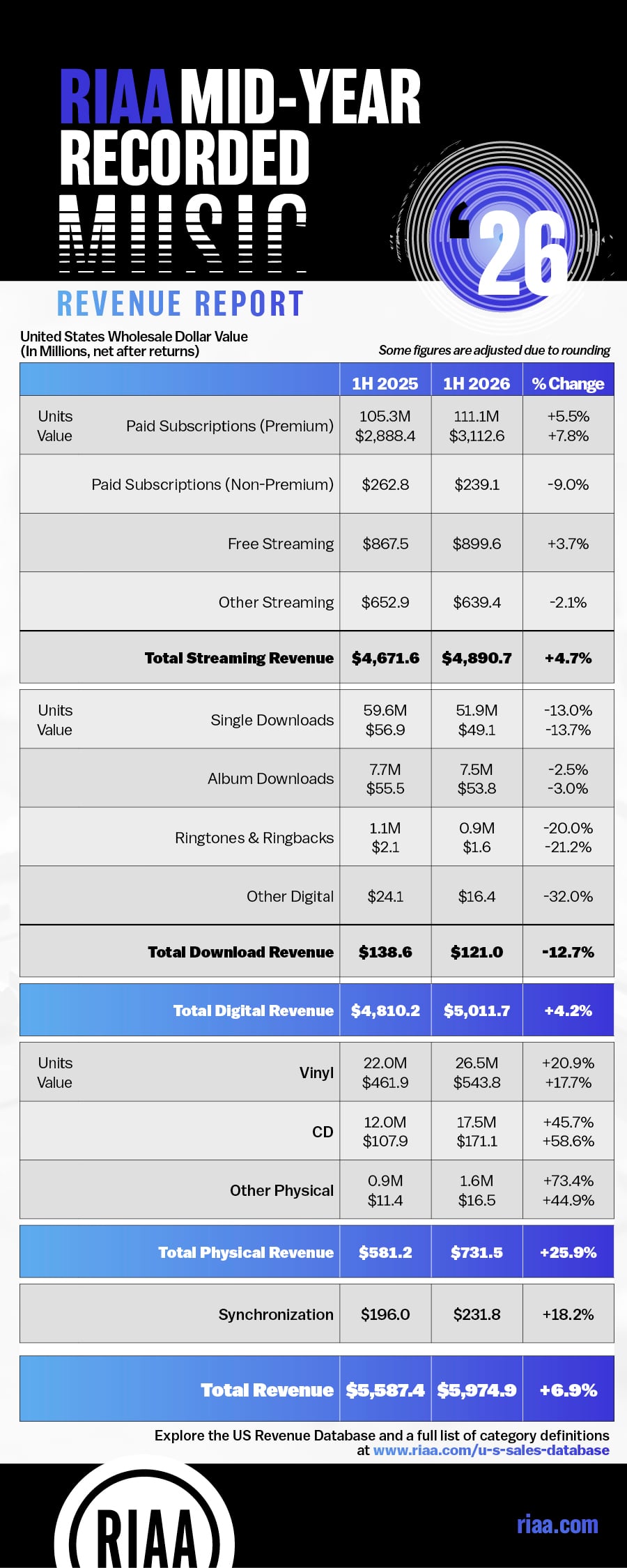
Those figures, which reflect wholesale revenues being paid through to labels and distributors, show that overall US recorded music revenues were up 6.9% YoY in H1 2026.
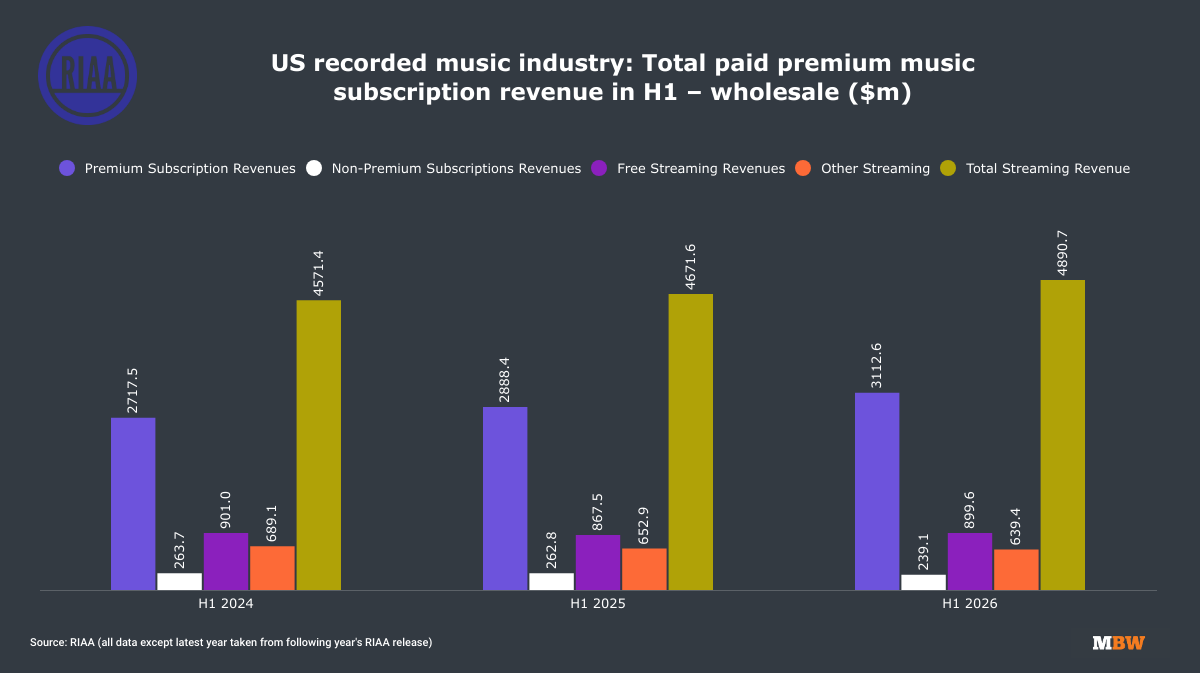
Streaming generated USD $4.9 billion, up 4.7% YoY, with paid subscriptions generating $3.4 billion in the period – up 6.4% YoY.
The RIAA defines paid subscriptions across two types of sub: (i) A ‘Premium’ subscription (providing unlimited, on-demand access to music, like Spotify, Apple Music etc.) or (ii) a ‘non-premium’ subscription (with device, catalog, or on-demand restrictions).
The ‘Premium’ subscription part of that equation generated $3.11 billion for rightsholders in H1 2026, up 7.8% YoY.
The other half of the equation – ‘non-premium’ subs, largely music bundled into services where music isn’t the main event – fell 9% YoY to $239.1 million.
The rise in ‘premium’ subscription revenue would have been partly driven by price hikes.
Music streaming platforms that raised their subscription prices in H1 2026 (affecting the YoY growth of these numbers) included Spotify, YouTube Music, and Amazon Music Unlimited.
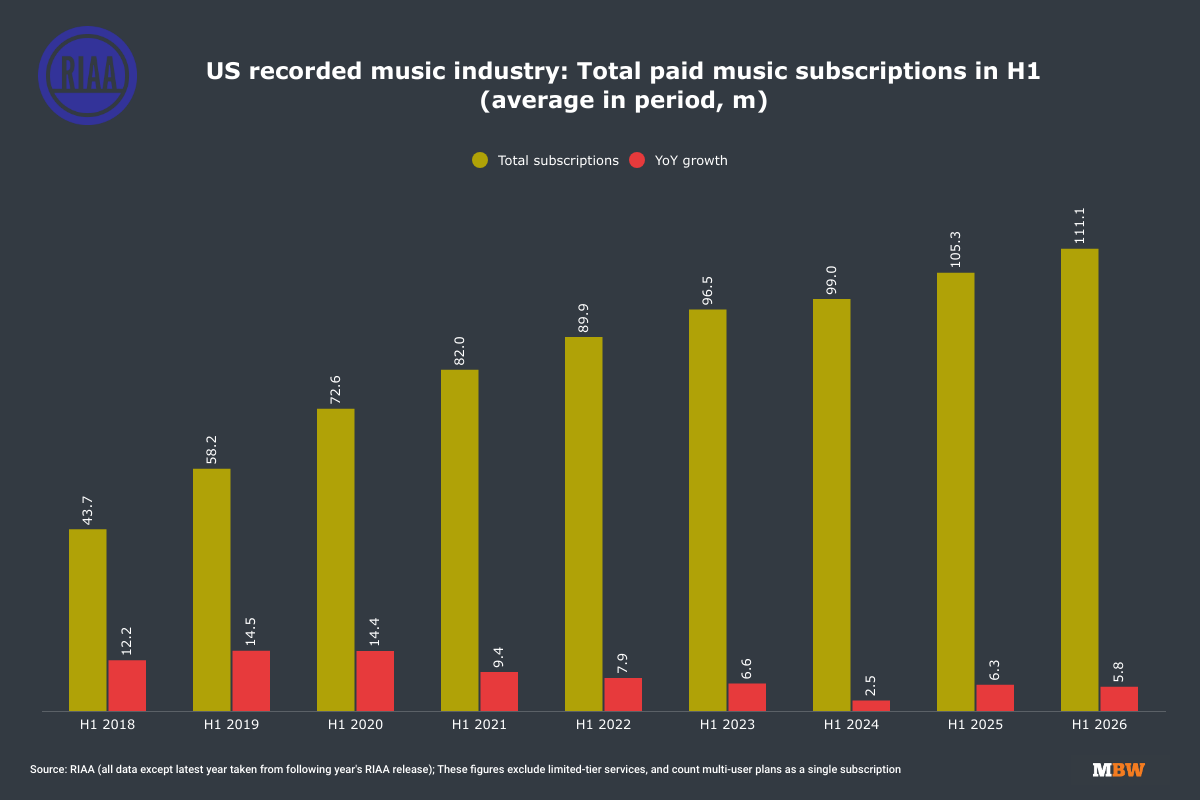
That said, the total volume of ‘premium’ subscription accounts in the United States also grew in H1 2026, up 5.5% YoY to 111.1 million. (The RIAA counts one family plan as a single subscription account.)
Free streaming services – which under the RIAA’s definition include social media platforms, as well as ad-supported Spotify and YouTube offerings – generated $900 million in H1 2026, up 3.7% YoY.
Physical music revenues jumped 25.9% YoY, powered by 17.7% vinyl revenue growth and a 58.6% increase in sales from CDs.
In total, across physical and digital platforms – plus sync – industry wholesale revenues hit $5.97 billion.
That was up 6.9% YoY.
“The power of music, amplified from earbuds to basement listening parties to World Cup playlists across the US, is reflected not only in its cultural significance but also in the $6 billion revenue documented in RIAA’s Mid-Year Recorded Music Revenue Report. These results point to a healthy, diversified marketplace supporting continued investment in artists and new ways for audiences to experience music,” said RIAA VP of Research, Matt Bass.
“As US music revenues continue to grow across formats, labels are strengthening connections between artists, fans and the platforms delivering creative work,” RIAA Chairman & CEO Mitch Glazier said.
“That partnership is driving engagement in new and expanding ways to create opportunities that will lift up the entire music community for years to come.”
RIAA Revenue Category Definitions:
- Paid Subscriptions (Premium): Premium-tier subscription services providing unlimited, on-demand access to music, paid under either trial or full subscription plans.
- Paid Subscriptions (Non-Premium): Music subscription services with limited interactivity (e.g., device, catalog, or on-demand restrictions) or bundled within broader offerings where music is not the primary service, such as fitness apps. Includes paid trials and full subscriptions.
- Free Streaming (formerly “On-Demand Streaming – Ad-Supported”): Ad-supported audio and music video services that do not operate under statutory licenses. Includes social media platforms (including ad-supported VOD and UGC), and free-tier audio subscription services delivered online or via mobile networks.
- Other Streaming (New in 2025): Combination of “SoundExchange Distributions” and “Other Ad-Supported Streaming” from previous reports. Estimated payments to performers and copyright holders for digital and customized radio services operating under statutory licenses, including SoundExchange distributions and similar direct deals.
- Single Downloads: Permanent single-track digital downloads.
- Album Downloads: Permanent full-album digital downloads.
- Ringtones & Ringbacks: Includes master ringtones and ringbacks. Prior to 2013, also included music videos, full-length downloads, and other mobile products.
- Other Digital: Digital music licensing revenues from kiosks, music video downloads, digital jukeboxes, and embedded services (e.g., in-flight entertainment).
- Vinyl: Full-length vinyl albums, including direct and special market sales.
- CD: Full-length compact disc albums, including direct and special market sales.
- Other Physical: Physical music formats other than standard vinyl and CD albums, including CD singles, DVDs, Blu-ray music videos, cassettes, MiniDiscs, SACD, DVD-Audio, and other formats.
- Synchronization: Flat fees or royalties derived from licensing sound recordings for use in television, advertising, film, video games, and other audiovisual productions.
Music Business Worldwide
On September 1, 2026, the Recording Industry Association of America (RIAA) released its half-year report detailing the state of the recorded music industry in the United States. The report highlighted a positive trend, showing an overall increase in recorded music revenues by 6.9% year-over-year (YoY) for the first half of 2026.
The streaming sector was a significant contributor to this growth, generating $4.9 billion, which was an increase of 4.7% compared to the same period in the previous year. Within streaming, paid subscriptions were particularly strong, bringing in $3.4 billion—up 6.4% YoY. The RIAA differentiates paid subscriptions into two categories: ‘Premium’ subscriptions, which offer unlimited, on-demand access to music (like Spotify and Apple Music), and ‘Non-Premium’ subscriptions, which have various restrictions, such as limitations on devices or catalog access.
The premium subscription revenue accounted for $3.11 billion in H1 2026, reflecting a 7.8% YoY growth. This increase was partially attributed to price hikes implemented by major streaming platforms, including Spotify, YouTube Music, and Amazon Music Unlimited. Despite the price increases, the total number of premium subscription accounts in the U.S. also rose, reaching 111.1 million, which is a 5.5% increase YoY. The RIAA counts family plans as a single subscription account.
In contrast, revenue from non-premium subscriptions declined by 9% YoY to $239.1 million. Free streaming services, which include ad-supported platforms such as social media and free-tier offerings from Spotify and YouTube, generated $900 million in H1 2026, marking a 3.7% YoY increase.
Physical music sales experienced a remarkable surge, with revenues climbing 25.9% YoY. This growth was driven by a 17.7% increase in vinyl sales, alongside a striking 58.6% rise in CD sales. Overall, the combined revenues from physical and digital platforms, as well as synchronization rights, reached $5.97 billion, reflecting the aforementioned 6.9% YoY growth.
Matt Bass, RIAA VP of Research, commented on the report, stating that the figures demonstrate the cultural significance of music across various settings, from personal listening to communal events like World Cup playlists. He emphasized that the $6 billion revenue recorded in the report points to a robust and diversified music marketplace, which supports ongoing investments in artists and innovative ways for audiences to engage with music.
Mitch Glazier, RIAA Chairman & CEO, remarked that as U.S. music revenues continue to rise across formats, labels are enhancing connections between artists, fans, and the platforms that deliver creative work. He noted that these partnerships are fostering engagement and creating opportunities that will benefit the entire music community in the long run.
The report also included definitions of the various revenue categories tracked by the RIAA:
- Paid Subscriptions (Premium): Services providing unlimited, on-demand music access under trial or full subscription plans.
- Paid Subscriptions (Non-Premium): Music subscription services with limited interactivity or bundled within broader offerings where music is not the primary service.
- Free Streaming: Ad-supported audio and video services that do not operate under statutory licenses, including social media platforms and free-tier audio subscriptions.
- Other Streaming: A new category combining distributions from SoundExchange and other ad-supported streaming services.
- Single Downloads: Permanent downloads of single tracks.
- Album Downloads: Permanent downloads of full albums.
- Ringtones & Ringbacks: Revenue from ringtones and ringback tones.
- Other Digital: Revenue from music licensing in various digital formats, including kiosks and embedded services.
- Vinyl: Sales from full-length vinyl albums.
- CD: Sales from full-length compact discs.
- Other Physical: Sales from non-standard physical formats, including DVDs and cassettes.
- Synchronization: Royalties from licensing music for use in audiovisual productions.
In summary, the RIAA’s mid-year report for 2026 indicates a healthy and growing recorded music industry in the U.S., driven primarily by the success of streaming and a resurgence in physical music sales. The data reflects a continued evolution in how music is consumed and monetized, with opportunities for both artists and labels to thrive in this dynamic marketplace.