
Before the pandemic, 8% of Live Nation‘s top 50 tours were by non-English-speaking artists. That figure now stands at 30%.
The figures come from Joe Berchtold, Live Nation’s President and Chief Financial Officer, speaking at Goldman Sachs‘ Communacopia + Technology Conference last Wednesday (September 9).
Soon enough, Berchtold expects the non-English-language share of the chart to surpass 50%.
“It’s not going to be that long where I’m sitting here saying now over half of our artists are not U.S., U.K. English-speaking artists,” Berchtold told Goldman analyst Stephen Laszczyk.
Berchtold framed the live business as one that has barely started its international phase.
“I think we’re absolutely still in the early innings,” said Berchtold. “Most of what we’ve seen in the last couple of decades is still largely a U.S., Western Europe phenomenon.”
Over half of Live Nation‘s fans are now based in markets outside the US – a country that accounts for 5% of the global population but still around half of LN’s business.
“As we focus on this as a truly global business, it has tremendous runway.”
Joe Berchtold, Live Nation
“Latin America is up for us 15 times in the past 10 years,” said Berchtold. “It’s still 1/10th the level of activity as the U.S. is. Japan, huge market, is 40% of the activity level of the U.S. on a per capita basis.
“Even Western Europe can grow another 25%. So I think as we focus on this as a truly global business, it has tremendous runway.”
A record 159 million people attended Live Nation shows in 2025. As previously reported, it was the first year in the company’s history in which more fans attended its concerts outside the United States than inside it.
Berchtold said Live Nation has sold over 155 million tickets so far this year, up 12% year-over-year, and is on track to reach around 175 million fans in 2026, moving toward a longer-term target of 225 million set at its investor day last November.
The constraint on that international growth, Berchtold explained, is not demand: it’s buildings.
He told the Goldman Sachs conference that 47 of the top 75 markets outside the US lack sufficient modern arena infrastructure.
This includes big cities, said Berchtold: “Rome, Istanbul, Frankfurt in Europe. It’s Seoul, Tokyo, and Manila in Asia. Latin America, you’ve got São Paulo, Rio, Lima.
“So very, very big cities. I’m not kind of trying to cherry pick these 47 cities you haven’t heard of. These are big markets that lack the infrastructure.
“So as we look to opportunities to either acquire or build arenas, modernize them, we think that can help drive our overall growth in terms of bringing more fans, driving more sponsorship, driving our ticketing business and fueling the overall system.”
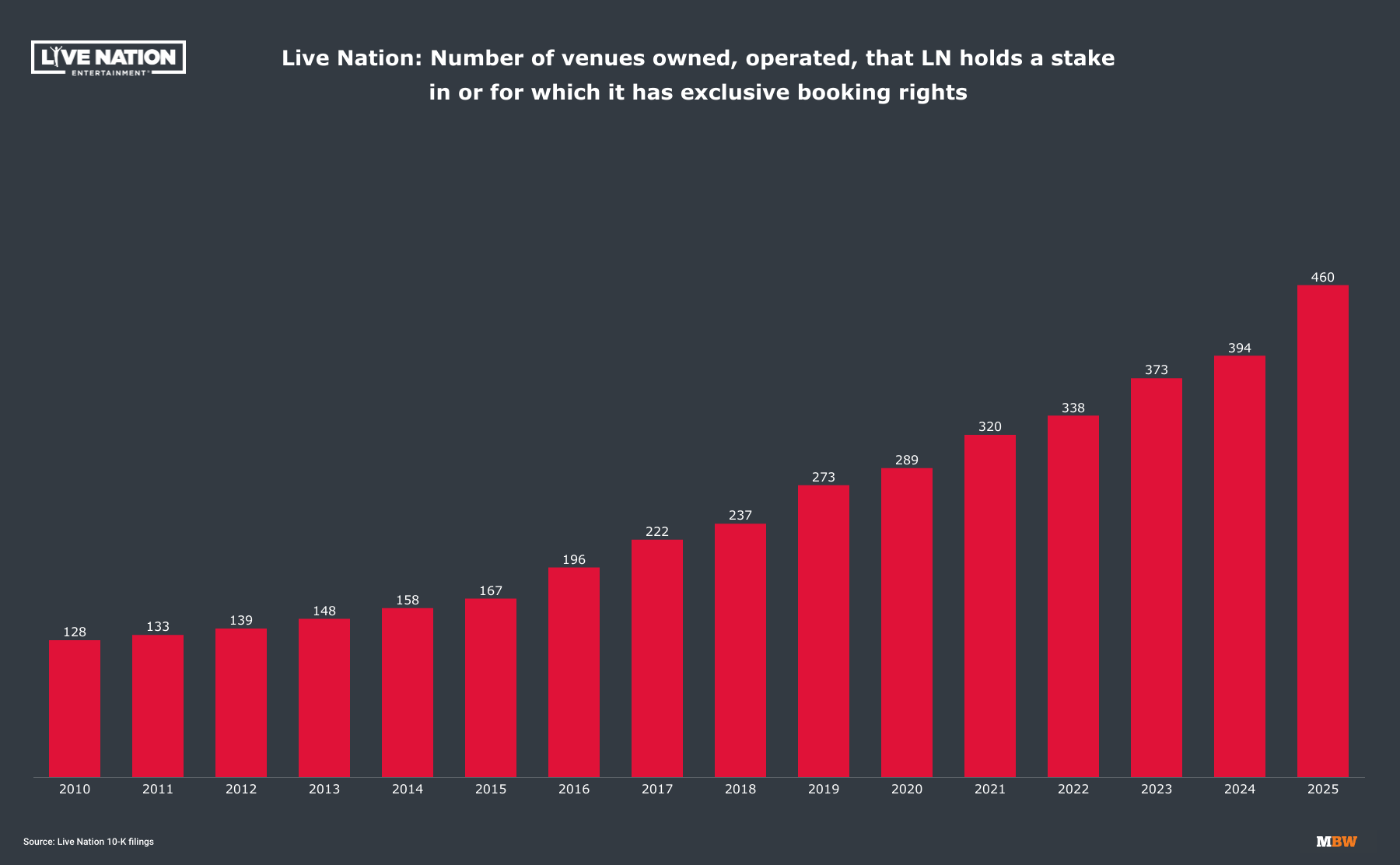
Live Nation now operates 25 arenas globally, up from five a decade ago, with 85% of the fans at those arenas in international markets.
The number of fans it hosts at its own venues has roughly doubled over the same ten years, to around 75 million. Berchtold said 70% of that increase has come from international markets.
“So I think next year, we’ll see – I think we’re going to start to unlock a lot more of the fan count from the arenas that we’re just getting open, the arenas that we’ve announced that we’re acquiring this year,” said Berchtold.
At its investor day in November 2025, Live Nation put 48 large venues in its pipeline, at a capital cost of around USD $5.2 billion.
Of those 48 planned venues, over half – 28 – are ex-US, Jordan Zachary, Co-President of US Concerts and President of Regions, said at the time.
Live Nation has completed four arena acquisitions since the start of 2026, in Santiago, Bangkok, Milan, and Buenos Aires.
In August, it agreed to acquire a majority stake in three Prague venues, including the 20,000-capacity O2 arena, in what it called its largest investment in Central and Eastern Europe to date.
Two of the cities Berchtold named at Goldman Sachs are already on the company’s build list.
Live Nation is building a 21,000-capacity arena in São Paulo, due to open in 2028, and has submitted plans for Lima Music Arena, an 18,500-capacity indoor venue in Santiago de Surco.
Berchtold credited social platforms and streaming services with changing which artists can fill those buildings.
“There’s not an artist out there who’s not using the social media platforms, the TikToks, YouTubes, Instagrams, to develop their brands,” he said. “They’re obviously using the DSPs to democratize the distribution so you can have fans everywhere.
“This is far and away from the old U.S., Western Europe, U.K. dominated artists out there. No. 1 artist post-COVID has been Bad Bunny, selling out stadiums globally.
“Obviously, K-pop has been a huge phenomenon. Latin in general. The No. 2 genre in Brazil is country music.”
Ticketmaster will begin selling tickets in Japan around the end of the year.
Back in the US, Berchtold said the economics of reaching a niche audience in a market such as Los Angeles have changed with it.
“But if you think about it,” said Berchtold, “if you’re an artist of a very specific genre, you only need 0.1% of the population in L.A. to be your community, right?
“So really, what’s happening is they’re able to reach that 0.1% much more effectively than you ever could before because there’s always one person in the group who’s the fan, who’s following the artist, who learns about the show in social media, who shares the music with their friends and brings them to the show.”
Asked how 2027 might shape up, Berchtold suggested the international story will eventually stop being a story at all.
“I think international markets will lead our growth,” said Berchtold. “But I think that’s going to start to be an irrelevant statement.”Music Business Worldwide
Before the COVID-19 pandemic, only 8% of Live Nation’s top 50 tours featured non-English-speaking artists. This number has surged to 30% post-pandemic, signaling a significant shift in the live music landscape. Joe Berchtold, Live Nation’s President and Chief Financial Officer, shared these insights at the Goldman Sachs Communacopia + Technology Conference on September 9, 2023. He anticipates that the share of non-English-language artists in top tours will soon exceed 50%, indicating a growing acceptance and demand for diverse music globally.
Berchtold characterized the live entertainment industry as being in its initial stages of international expansion. He noted that the majority of the industry’s activity over the past few decades has been concentrated in the U.S. and Western Europe. However, a notable change is occurring as over half of Live Nation’s fan base is now located outside the United States, which represents only 5% of the global population but contributes about half of the company’s business. Berchtold underscored the enormous potential for growth as Live Nation pivots towards a truly global business model.
Live Nation has experienced remarkable growth, especially in Latin America, which has increased its business activity fifteenfold in the past decade. Despite this growth, Latin America operates at only one-tenth the level of the U.S. market. Similarly, Japan’s market activity is 40% of the U.S. on a per capita basis, and Western Europe still has room for a 25% growth increase. The potential for international expansion is substantial, with Berchtold emphasizing that the company is still in the early stages of this journey.
In 2025, a record-breaking 159 million people attended Live Nation shows, marking the first instance where more fans attended concerts outside the U.S. than within it. As of this year, Live Nation has sold over 155 million tickets, a 12% increase year-over-year, with projections of reaching around 175 million fans in 2026, eventually aiming for a target of 225 million set during an investor day last November.
However, Berchtold pointed out that the primary constraint on international growth is not demand but rather the lack of modern arena infrastructure in many key markets. He highlighted that 47 of the top 75 markets outside the U.S. lack adequate facilities, including major cities like Rome, Istanbul, Frankfurt, Seoul, Tokyo, Manila, São Paulo, and Rio. These cities present significant opportunities for growth if Live Nation can either acquire existing venues or build new ones, thereby driving attendance, sponsorship, and ticket sales.
Over the past decade, Live Nation has expanded its global portfolio to 25 arenas, up from just five, with a significant 85% of fans attending these venues coming from international markets. The number of fans served at Live Nation’s locations has approximately doubled, with 70% of this growth coming from international audiences. Berchtold expressed optimism for the future, stating that new arenas opening and acquisitions made by the company would unlock further fan engagement.
At its investor day in November 2025, Live Nation outlined plans for 48 large venues, with a capital investment of approximately $5.2 billion. Of these venues, more than half (28) are located outside the U.S. The company has already completed four arena acquisitions in Santiago, Bangkok, Milan, and Buenos Aires since early 2026. In August, it announced its largest investment in Central and Eastern Europe to date, acquiring a majority stake in three venues in Prague, including the 20,000-capacity O2 arena.
Live Nation has ambitious plans for new constructions, including a 21,000-capacity arena in São Paulo, scheduled to open in 2028, and has submitted plans for an 18,500-capacity venue in Santiago de Surco. Berchtold attributes some of this shift to the impact of social media and streaming platforms, which have transformed how artists connect with fans globally. He noted that artists now have the tools to develop their brand and reach audiences everywhere, leading to a more diversified range of successful acts.
The post-pandemic landscape has seen artists like Bad Bunny achieving phenomenal global success, and genres such as K-pop and Latin music rising rapidly in popularity. In Brazil, country music has even become the second most popular genre. Ticketmaster is also set to expand its offerings in Japan by the end of the year, further indicating the company’s focus on international markets.
In the U.S., Berchtold emphasized that the economics of reaching niche audiences have evolved, allowing artists to connect with smaller segments of the population more effectively than in the past. Artists can now mobilize their dedicated fan bases through social media, which enables them to promote their shows and music more efficiently.
Looking forward to 2027 and beyond, Berchtold believes the narrative of international growth will become less prominent as it becomes the norm. He predicts that international markets will lead Live Nation’s growth, asserting that the distinction between U.S. and international artists will fade as the company’s global presence solidifies.
In conclusion, Live Nation’s strategic focus on expanding its international footprint and diversifying its roster of artists reflects a transformative moment in the live music industry. With increasing attendance from global markets and the company’s ongoing infrastructure investments, Live Nation is poised for significant growth in the coming years, driven by a broader acceptance of music from non-English-speaking artists and an expanding global fan base.